

What's in this blog
A traditional Gadwal cotton saree is woven with a fine cotton body and a pure silk border and pallu, joined together by hand using an interlocking technique called Kuppadam. The body breathes like cotton. The border carries the weight, zari and contrast color of silk. No stitching holds the two together, only the interlock itself, thread by thread. While most Gadwal sarees sold today are woven entirely in silk, understanding this original cotton-silk construction is the clearest way to recognise an authentic Gadwal weave, regardless of which fabric variant you are buying. It is also why the GI tag protecting the name is tied to a place, Gadwal in Telangana and a technique, not to silk content alone.
Table Of Contents
Quick Reference
| Attributes | Detail |
|---|---|
| Weave name | Gadwal, also called Sico (silk-cotton) |
| Origin | Gadwal town, Jogulamba Gadwal district, Telangana |
| Joining technique | Kuppadam interlock, hand-joined thread by thread, no stitching |
| GI protection | Registered around 2010; tied to the Gadwal weaving cluster |
| Best occasions | Festivals, temple visits, summer weddings, daily silk wear |
The Cotton-Silk Origin Most Buyers Miss
Most people searching for Gadwal sarees assume they are looking at a silk saree with a fancy name, the way they might think of a Kanjivaram or a Banarasi. That assumption misses the actual engineering. The original Gadwal, sometimes called a Sico saree (silk plus cotton), was built from two different yarns woven as two separate pieces and then joined by a weaver's hand, thread by thread, in a method known locally as kuttu or Kupadam. The cotton body kept the saree breathable enough for a Telangana summer. The silk border and pallu carried the zari, the contrast color and the weight a festive or temple saree needed. Traditionally, exceptionally fine Gadwal sarees were famously said to fold small enough to fit inside a matchbox, demonstrating the fineness of the weave. While largely symbolic today, it remains one of the best-known stories associated with classic Gadwal craftsmanship.
This is not a footnote in Gadwal's history. It is the entire reason the weave exists the way it does and the reason a genuine border feels different under your fingers than a printed or power-loom imitation does. The same logic of construction over fabric content shows up across South Indian handlooms, our Banarasi authentication piece covers it for a very different weave, but the principle of checking how a saree is built, not just what it's labeled, holds across all of them.
Characteristics of a Traditional Gadwal Cotton Saree
| Body | Fine-count cotton |
|---|---|
| Border | Pure silk |
| Pallu | Pure silk |
| Joining method | Handwoven Kuppadam interlock, no stitching |
| Feel | Lightweight and breathable |
| Best for | Festivals, temple visits, summer weddings |
Gadwal cotton sarees sit in a category of their own in the handloom world because neither end of the fabric is a compromise. The cotton field is genuinely fine-count, not the rough or medium-weight cotton used in everyday draping sarees. The silk border is genuinely silk, with real zari in the better pieces. The result drapes more lightly than a full silk saree while still looking like one from any distance that matters, which is why Gadwal cotton sarees have always been favoured for long ceremonies, summer weddings and temple occasions where wearing eight or nine yards of silk for hours is impractical.
Why Most Gadwals Sold Today Are Pure Silk
| Body weight | Lighter | Richer, heavier drape |
|---|---|---|
| Breathability | High | Moderate |
| Occasion fit | Festivals, summer weddings, temple | Bridal, evening occasions |
| Construction | Kuppadam interlock | Kuppadam interlock |
| Zari | Silk-border zari | Full zari options available |
The construction is identical in both. What changes is the body yarn and the drape that results from it.
At Tulsi Silks, our Gadwal silk sarees collection is pure silk, built on that same Kuppadam technique. We're flagging the cotton-body original here because understanding it is what lets you actually judge whether the silk piece in front of you was made the right way, not because we're selling the cotton version. If a seller cannot explain why a Gadwal has a separately woven border at all, they likely don't understand the weave they're selling. It's the same scrutiny worth applying across our silk sarees range, construction first, fabric content second.
How to Identify a Genuine Kuppadam Interlock
The interlock is the single most reliable thing to check, in person or from photographs before you buy.
- Run a finger along the inside seam where the border meets the body. A hand-joined Kuppadam interlock leaves a faint, slightly raised seam with small variations in tension, because no two passes of a weaver's hand are identical. A visible, slightly irregular ridge at that join is a strong indicator of traditional Gadwal construction. An unusually flat, perfectly uniform seam may indicate machine production or a different construction method and is worth examining alongside the other checks below rather than treating it as conclusive on its own.
- Turn the saree over. The reverse side of a handwoven border shows visible floating threads and the structure of the weave. A power-loom imitation often has a cut, finished back that looks suspiciously identical to the front, which a hand loom cannot physically produce.
- Look closely at the motifs themselves, particularly temple gopurams or peacock patterns on the pallu. Genuine handwoven motifs show tiny, human variation from one repeat to the next. Motifs that are identical down to the millimeter were made by a machine.
- If real zari is used, gently work loose a small length of thread at the pallu edge. A silk core wrapped in metal suggests genuine zari. A plastic or synthetic core does not and that zari will flake or dull faster than the saree itself.
Finally, check for a Silk Mark tag from the Silk Mark Organisation of India on the silk components. It is not proof of the weave technique on its own, but paired with the seam and reverse-side checks, it closes the gap.
From Our Collections
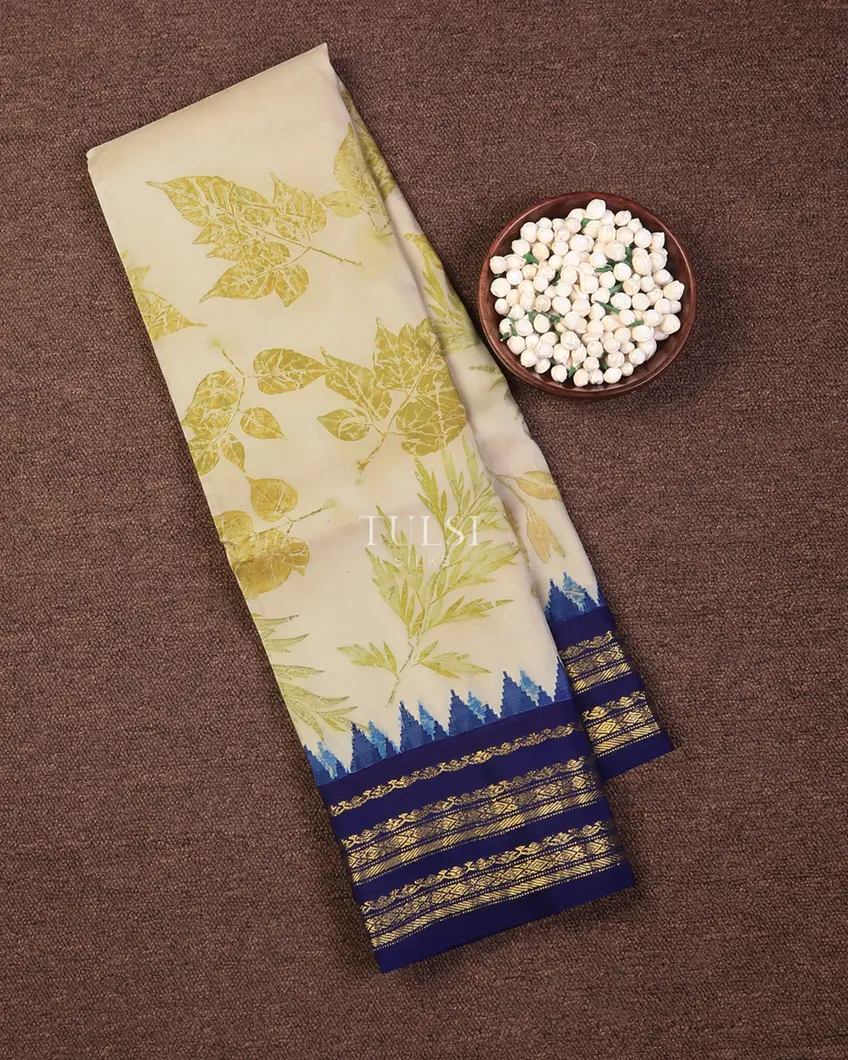
This Gadwal silk saree pairs an off-white botanical print with a striking royal blue temple border, finished with traditional zari weaving that brings depth and definition to the drape.
What "Semi Gadwal" Actually Means
You will see "semi Gadwal" listed on some sites at a noticeably lower price than a full Gadwal. The term usually refers to a saree with reduced zari coverage, a narrower border, or a lower silk content in the contrast sections, while still using the Gadwal interlock construction. It is not automatically fake, but it is a different product than a full-zari, full-border piece and the price difference should track the actual material and labor difference, not just a marketing label. If a seller can't tell you what specifically makes their piece "semi," ask before you pay full-Gadwal pricing for it. For lighter festive wear where a full zari border would be too heavy, browse our festive sarees collection for comparable weight options.
Common Mistakes Buyers Make
The most common mistake is assuming heavier automatically means more authentic. A genuine Gadwal, cotton-bodied or silk-bodied, is built to be light relative to its visual richness. That lightness is the point of the engineering, not a sign of a cheaper piece.
The second mistake is judging authenticity purely by price. A low price on a saree claiming dense zari and elaborate motifs is a real warning sign, but a high price alone doesn't confirm a hand-joined interlock either. Check the seam.
The third is assuming "Gadwal silk saree" and "Gadwal cotton saree" are competing products where one is more "real" than the other. They are the same construction technique applied to two different yarns, separated by decades of changing buyer preference, not by authenticity. If you're choosing between a Gadwal and something like a Kanjivaram silk saree for a wedding function, the decision should come down to weight and occasion, not which one is "more authentic."
Explore Gadwal Sarees
View AllDiscover Gadwal sarees woven with striking contrast borders, timeless motifs and the craftsmanship that has defined this weave for generations.